The 2nd SMPTE Annual International Conference on Sterescopic 3D for Media and Entertainment took place in New York on 21st and 22nd of June 2011.
Over twenty researchers and engineers presented papers on topics ranging from stereoscopic 3D viewer comfort to advancements in holographic 3D.
Igor Ridanovic spoke to German stereographer Daniele Siragusano who presented his research on stereoscopic volume deformations at the SMPTE conference.
IR: Please tell me about the facility you work for and your recent stereoscopic 3D projects.
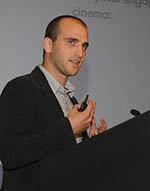 DS: I work for Germany’s largest post production company CinePostproduction. Founded 100 years ago as Geyer film lab in Berlin today we offer the complete range of film processing, digital post production, workflows and on set services for digital and stereoscopic cinematography including DCPs and prints for theatrical release in Munich, Berlin, Hamburg and Cologne.
We did the post production for the first European animated stereoscopic 3D film Animals United. We did Stereo-sweetening for The Darkest Hour and the post production for a converted movie called Hybrid. Currently we are involved with the S3D sweetening of Vicky and the Treasure of Goods and we are doing sound mixing of The Three Musketeers at our sound studios in Munich.
We’ve done a lot of commercials and shorts as well although we’re not a commercial house. But production companies come to our facilities because we know how to do 3D. We’ve done shows for German car manufactures and two or three projects with universities.
IR: Your approach to stereoscopic post production combines rigorous testing which is not unlike that of the researchers who presented papers at the SMPTE stereoscopic conference, but you also have the advantage of working on live action material. Are your research findings ever at odds with what you see on the screen?
DS: Yeah, the good thing about my position is that I can do all the research and see the final product on the screen, and since stereoscopic perception is a cognitive process, you can do all the math and it will only explain one part of the whole story. But there are lots of cognitive processes as well and you can not really put them into numbers. It’s really important to understand both the theory and the real life results.
IR: Perhaps it’s fair to say the scientists who study the stereoscopic 3D are at disadvantage because they don’t get to work with live action material on large screens?
DS: One part of the scientific process is to isolate and explore one special subject and ignore the sum of all parts. When it all comes together in one image, one frame, many factors are added together. It’s important to have the research but you also have to experience the S3D.
IR: How much R&D do you put into each film project?
DS: Quite a lot. For every big show there is a lot of R&D going on. There is always something new.
For example, we had a show in which the director wanted to add grain because there was a film within the film plot. We started to experiment with grain in stereoscopic 3D. We put different grain in each eye but this was unfusable by the viewer. Then we added the same grain to both eyes, but this looked like a wall of grain in the 3D space. Finally, we converted the grain so it had the same depth as the object it occluded. The visual effect was that the surfaces were grainy.
We’re also digging into new ways of modifying stereoscopic characteristics and changing the depth of individual objects in the scene in order to support the storytelling.
IR: In a recent film you manipulated the vertical parallax in order to induce unpleasant sensation in the viewer. Do film directors typically understand the new tools that are at their disposal or do you find yourself in the position to educate them?
DS: We definitely consult with directors about the possibilities. For a lot of directors I work with it’s the first time they do stereo and they appreciate any help they can get. For the post production side of things we’re getting involved much, much earlier, even before the storyboarding. They come to us at the early stage of the production so we can show them what flexibility they have in post and what they should get right on set—what we can not fix in post.
IR: What’s the situation in EU and in Germany in particular regarding stereoscopic training for film and TV industry professionals?
DS: I am teaching a course at the University of Television and Film Munich and there are stereoscopic consultants who offer courses, but there could be more, it’s just the beginning. I work for several universities as a lecturer. They are starting doing R&D on the university side, but I think it will take two to three years until they really get this deep understanding of how to deal with real life S3D problems. But we get some educated people from the universities, who have the basic understanding of stereo.
